Thursday, 14 July 2016

11 YouTube Video Marketing Tips For Maximum Results

11 YouTube Video Tips For Maximum ResultsWere you aware that 70% of all the traffic on the Internet today comes from videos? That is a pretty unbelievable number when you consider it.

Here are 11 tips on how you can create and market your YouTube video to get better results.

1. Post your videos on other social media sites besides just YouTube. These could include Twitter, Facebook, Stumbleupon, and Digg. Post it on your blog as well. Send a mailing out to your e-mail list and invite them to visit your blog and watch the video and leave comments.

2. Make your videos professional. Do not cut corners on sound and edit them so they are presentable. This should include lighting and color that is easy on the eyes.

3. Keep your videos short and on message, especially if you are doing a verbal presentation. I am not going to sit through a 10 minute video and neither are most of your viewers. Get to the point and then wrap it up. You can say a lot in a 2-3 minute video.

4. Just as in blogging, find ways to make your videos unique. This should include humour, controversy and really useful information that is not recycled from other people's videos.

5. Use your YouTube video to brand yourself and your business. Include your website logo, and your website URL in the beginning, in the text, and at the end. Videos really give you a great chance to come across as an expert on what your video is about.

6. Before you tape it 'live', practice it a few times. This will give you confidence because you know exactly what you are going to say. Never create a video on the fly.

7. Think about creating a series of videos on one theme. This can bring people back to watch more of what you have to say. It also will help you break your video into smaller portions so you can really stay on message for each one.

8. Get search engine benefits by incorporating targeted keyword phrases into the title of your video. You should build a keyword list and know what you are trying to rank highly for. Search engines love to rank videos on their search results for fresh and unique content.

9. Ask your viewers to leave comments. This helps get them involved and let you know what they are thinking.

10. Track your hits by using YouTube Insights to see who is watching your video and where they are coming from. Just as analytics are helpful on your blog or website, they can give you a lot of good information about your video.

11. Have fun. Do not swear or use inappropriate actions in any way. Do not offend people when you are having fun with off color jokes or comments.

These are 11 ways the experts create YouTube videos and market them to build their business. If you are not applying video marketing, you need to start today!

Friday, 8 July 2016

A Bird's Eye Summary Of 10 Traffic Generation Methods

A Bird's Eye Summary Of 10 Traffic Generation MethodsThe one common purpose of every website is to attract visitors. Without visitors a website does not have any effect or influence. In this article we will be looking at 10 traffic generation techniques that can be implemented to attract more visitors to your website.

Nothing is for free and without hard work and dedication these techniques will not guarantee success. For the best results it is advisable to use a combination of the 10 techniques as part of your traffic generation strategy.

1. Article Marketing

Consumers use the Internet to get information on the topics that they are interested in. More information will be available on popular topics (celebrities, news, and more) than on niche topics. In order for article marketing to work you have to find a niche market to write about. Not all niche markets will generate traffic and you need to experiment a bit. The best part of article marketing is the fact that the costs are very low. There is however an investment in time. Articles need to be original, unique and well written in order to attract visitors through your text links within the article or resource box. Readers who find your article informative will point other users to your article through blogs, forums and bookmarks.

2. Video Marketing

The use of video as a marketing tool has increased dramatically over the last couple of years. Video can be used in various different ways to market your website or products. Videos can go viral easily and can attract a lot of customers to your website. Youtube is still the best site to post videos to but there are a number of high quality video sites available.

3. Social Sites

Facebook and Twitter are 2 examples of social media sites that have grown rapidly in a short period of time. The benefit of social media is the instant interaction with your consumer base. Google also lists Tweets in the search result pages and this can lead to additional exposure. You can integrate most of the social media sites with your website to allow visitor interaction. If you are serious about generating traffic to your website, you need to make use of social media to market your site.

4. Forums

Partaking in relevant forums or discussion groups through comments, questions or posts is still a very good traffic generation technique. You need to research related forums and join the high ranking trusted ones. With forums the key is your signature link. Use a signature link that entices the reader and that results in visits to your site.

5. Blogging

It is very easy to start a blog and the costs are very low. Look at creating a blog linked to your website and post relevant information on the blog daily. Ping your blog to ensure that it is picked up. You can also link your blog posts to your Twitter profile. If you post high-quality and informative content, visitors will follow!

6. Social Bookmarking

Bookmarking your site on websites like Digg, StumbleUpon and Reddit will results in one-way links back to your site. It is also a great way to gain more exposure for your website. Use the bookmarking sites for your own use by bookmarking sites that you like. Make sure that these bookmarking sites are integrated with your website to allow visitors to bookmark your site.

7. Podcasts

Podcasts can be a great traffic generation tool. You can either publish a podcast or be a guest on an established podcast. Find podcasts or Internet radio shows that focus on a relevant subject and find out how you can become a guest speaker. Good podcasts are normally referred to friends and can go viral resulting in traffic to your website.

8. Banner Advertising

Look at using low-cost banner ads on large ad networks. Banners can attract attention in some websites and can be a great traffic generator. There is no need to spend thousands in the beginning and a banner with a simple sales message is just as effective.

9. Press Releases

Submitting a press release about your site whenever there is something to announce will generate traffic. Search for free press release templates if you want to write your own press release. Unlike article writing, do not overdo it; only submit a press release if you have something to announce.

10. Pay-Per-Click

Pay-Per-Click campaigns can be profitable or cost you a lot of money. What makes this form of advertising ideal is that you reach your identified target market directly and should therefore achieve a higher conversion rate. The key to a successful Pay-Per-Click campaign is great ads with perfectly targeted keywords. You might have to experiment a bit in the beginning with your ads and it is advisable to set a limit on the cost.

Generating traffic to your website is not as easy as it looks. If you are not familiar with any of the above techniques, please research them further before implementing them. Remember that the above techniques will also generate backlinks to your site and should therefore improve the position of your keywords on the search results pages and improve organic traffic to your site.

Thursday, 30 June 2016

Video Marketing: 10 Tips For Using Videos To Market Your Business

10 Tips for Using Videos to Market Your Business You want to use as many media as your business allows you to market since you're reaching a wider audience than you would with text alone.

Some prospects respond better to video than they do to text, so here are 10 tips and tricks for using video to market your business:

1. Keep 'em short

Whether you're loading videos on YouTube or you're using them to pre-sell products on your blog, keep them short (around 5 minutes or so)…especially if your audience includes people who don't know you.

If needed, break a long video into multiple smaller videos. From experience, I found that if people knew beforehand how short they can expect a video to be, they will be more willing to sit through it.

2. Post videos on your sales pages

You can use video salesletters to highlight the main points of your regular salesletter. You can also use videos to demonstrate what the product is and how easy it is to use.

You may also get your satisfied customers to give you video testimonials.

3. Choose your keywords carefully

If you're loading your videos onto YouTube, choose keywords that your market is currently using to find information in your niche.

You may also choose keywords that match those being used alongside other popular videos in your niche.

4. Know your purpose before you start

Before you film, choose one purpose for your video. Is it to get subscribers? Send traffic to your blog? Pre-sell a product?

Whatever the reason, base your entire video around that singular goal.

Don't confuse your viewer by giving more than one option.

5. Create a call-to-action

You should create at least one call-to-action in your video, where you tell people exactly what you want them to do and why (e.g. "Go to yourdomain.com to grab Part 2 of this video, but hurry, you can only get it free for a limited time!").

6. Encourage comments

If you're posting your video on YouTube, on your blog or other social sites, encourage comments (even controversial ones). The more people talk about your video, the more your visitors will return to your page to see what's new in the discussion.

7. Use other social sites to jumpstart the viral effect

If you want your video to go viral, you need to promote it. One way to do that is to link to or embed your video on your social media pages.

8. Blog about your video

Another way to promote your video is to blog about it. If you embed your video on your blog, then encourage your visitors to social-bookmark it.

9. Ask your JV partners to share your video with their prospects and customers

Yet another away to advertise your video is by asking your JV partners to mention it in their newsletters, blog about it and share it with their social media contacts.

10. Put a video on a CD/DVD and give it away for free

You can build a physical mailing list by putting your video on a CD or DVD and giving it away for free to those who give you a mailing address. Be sure to include an upsell at the end of your video.
In summary: You can use videos to pre-sell products, demonstrate products, teach your prospects, drive traffic to your sites and grow your mailing list. Start applying these tips today and you'll be amazed at what video marketing can do for you.

Saturday, 25 June 2016

9 Tips For A Successful Email Marketing Campaign

9 Tips For A Successful Email Marketing Campaign
Email marketing is still an indispensable marketing channel. How do you get your emails to stand out from the others in your readers' inbox? Here are 9 tips for you:

1) Appeal to your buyer persona: Any marketer can write a generic email to his/her prospects, but it takes a real conversion expert to nail down the precise content that addresses your customers' needs, lifestyles and even apprehensions. When you can define the likely customer profile that buys your product or service, you will have the capacity to think of a ready answer to address your customers' challenges. By placing ourselves in the shoes of our prospects, we can better pre-empt their purchasing decision.

2) Focus on the beef of the message: Each email should have one clear message. I know this practice goes against those who publish regular ezines or newsletters with multiple articles or sections, but the benefits are:

a. You take less time and effort to complete an email
b. You can space out your content into an email series
c. Your readers are more likely to act on a strong call-to-action

So the point here is to avoid excessive content. Create the specific message using brevity and conciseness. Your customers will respond more positively to a message that is easily understood and goes straight to the point.

3) Exclusive specials to email subscribers: Offer special promotions and discounts that are only available for those on your mailing list. Or provide valuable information that is not included on your website. Another way is to use gated content to 'force' website visitors to subscribe to read the full content. Sending holiday messages or birthday greetings (plus birthday-only promos) to enhance the business relationship.

4) Branding: Whatever distinctive design elements and styles your company already uses, such as logos, fonts, and color schemes, should be incorporated into the emails you send out too. This will cause your readers to instantly recognize your company.

5) Strong call-to-action: It's best to begin with the end in mind. Tell your readers exactly what they have to do. Make your links or graphical buttons stand out.

6) Take advantage of preheaders and make email previews work to your advantage: A preheader displays the initial line of the email body, with the text highlighted. Gmail and many other email platforms show this first line right after the subject line, so that is one easy way to get the attention of a subscriber.

7) Always proofread any correspondence that you send: This may seem obvious, but it is easy to get caught up in the informality of emailing. It's just email, right? Actually, that couldn't be farther from the truth! Every e-mail you send is a direct reflection of your business.

8) Whitelisting: Remind your readers to whitelist your email address so that your emails will not land in their spam folder.

9) Mobile-responsive design: With emails being read on a gamut of devices, it becomes necessary to design them for readability across the board.

Following these 9 tips will go a long way to ensure you can run a successful email marketing campaign. Are there other tips I have not covered. Feel free to comment below. Have a great day!

Sunday, 12 June 2016

Lead Generation: 10 Tips For Getting More Subscribers

10 Tips For Getting More Subscribers
More subscribers are almost as good as money in the bank, so here you go...

1. Include a call-to-action at the end of your blog posts.

Let your visitors know that if they like your blog posts, they'll love your newsletter content.

That's because you save some of your best niche tips, tricks and secrets for subscribers.

To get more subscribers, include a link to your landing page at the bottom of your posts, along with a reason to click on that link.

Example: Discover 101 more weight loss tricks for free—click here!

2. Encourage a viral effect.

You can get more subscribers simply by including a note at the bottom of every newsletter where you encourage your existing subscribers to forward your email to their friends, family and colleagues who could benefit from the information.

Example: "Do you know someone else who could benefit from these dog training secrets? Please forward this e-mail to them—they'll thank you for it!"

3. Use your forum signature file to get new subscribers.

If you're visiting busy niche forums, include an ad and a call-to-action in your forum signature.

Example: "Free report reveals the health secrets your doctor doesn't want you to know! Click here to claim your copy now..."

4. Point your social followers to a free report.

Make full use of social media sites—Twitter, Facebook, Google+, LinkedIn, Pinterest—to grow your list.

Simply point your fans and followers towards your squeeze page to pick up a free report. Include this link on your profile page as well as in some of your posts.

5. Embed your links in your products.

Include links in your free reports too and encourage your readers to share what they have read with their friends.

6. Drive traffic to your landing page using videos.

You can create YouTube.com videos for the sole purpose of driving traffic to your newsletter sign-up page.

To get the best results, include a call-to-action at the end of your video where you promise viewers they can get the second part of the video—for free—when they join your list.

7. Tap into Hubpages to get new subscribers.

Create Hubpages.com pages around niche topics with the purpose of driving visitors and point as many links as possible to your landing page.

8. Co-promote with others in your niche.

Here you can swap endorsements with your partners. You can post your endorsements on your respective blogs as well as in your newsletters. I've also very successfully done ad swaps where I swap ads with other marketers.

9. Unleash the power of content marketing.

First create a multi-part article series around a niche topic.

Then upload Part 1 to the article directories (such as: EzineArticles.com, GoArticles.com and IdeaMarketers.com) and upload the rest of the series to your autoresponder.

Use your article byline to encourage people to get the rest of the series (starting with Part 2) by clicking through to your squeeze page.

10. Form a newsletter co-op.

Do a co-registration deal with one or more people in your niche, that is, when a prospect joins your partners newsletter, they also get the option of joining your newsletter at the same time (simply by checking a checkbox).

Summary...

You can use each of these 10 lead generation methods to get dozens, hundreds or even thousands of new subscribers. Test them out, track performance and do it over and over again. Just imagine how big your list will be once you apply all these methods.

Friday, 10 June 2016

eBook Writing: Simple 6-Step Process To Writing Your Own eBook

Simple 6-Step Process To Writing Your Own eBook One of the simplest paths to gain standing, leads, credibility and trust from your clients is to write your own ebook.

Many people are intimidated by the idea of ebook writing but the truth is, the process is really straight-forward and it can be terrifically profitable. If you're already involved in activities such as blogging, article marketing and making relations with newsletters, an ebook is just one step beyond in the entire process but can truly give your credibility rating an additional boost.

Bear in mind that for an ebook to work the way in which you need it to, it must truly look at the issues, concerns, or needs of your market. The content must be top-notch. Here are 6 steps to writing your own ebook:

1. Select a subject for your target market. Don't make this into a huge product. Pick something relatively narrow within a major topic. For example, if the main topic is Inbound Marketing, select something that fits within that category like SEO, or you might go even farther and simplify it down to "SEO for landing page design".

2. Brainstorm. Write down each idea you have, walk away and come back and write more. Put down everything and anything for now.

3. Organize your concepts into an outline. Divide your ideas into headers, subheaders, chapters and write descriptions of each point you include. Make sure to keep an eye on your references and write those down too.

4. Research. Hopefully you have picked a topic that you are acquainted with already but whether you have or haven't you'll need to do research to make your content as valuable as possible. Take notes, mark references and use quotes as you write your own ebook.

5. Put all of your organized ideas and research into a particularly long article of at least thirty pages. This is your ebook! As you write, you will instinctively know where your content has fallen short. Go back to brainstorming and researching for expanding on new or current ideas.

6. Get a second opinion. Probabilities are you'll spend rather a lot of time on this enterprise. Make sure that you step back every once in a while to give yourself a break. And when you're near the end, ask somebody else to read it for a more objective opinion. Whether it's your mate, better half or a fellow marketer, ensure you get a good, honest critique and, if possible, an edit of your work.
Once you are finished, you can either sell your ebook from your blog or site or you can offer it free of charge for people who sign up, the goal of which is to build your list.

If you decide on the first option, you'll have to line up a payment system. You don't have to charge a lot for your ebook to earn income (unless it has something real good) and as it doesn't cost anything to make the book (if you do not count the time you spend on it) so anything you sell will be a profit.

So now are you ready to draft your own ebook?

Monday, 23 May 2016

6 Types Of Email Content For Your Lead Nurturing Campaigns

6 Types Of Email Content For Your Lead Nurturing Campaigns
Insofar where lead nurturing is concerned, we learned that the process is conducted via an automated email series. For sure, the emails are written in a specific manner, not filled with sales pitches (these can be included but more sparsely and tactically, to be elaborated in point 2 below), but useful, low-commitment information that culminates in a middle-of-the-funnel call-to-action that appeals to the concerns of the sales leads at the next level.

So what type of email content can you write? We present 6 types for your consideration:

1) Educational email content: At least, being educational is fundamental to getting your leads become familiarized with your business. You could start with some general educational emails that feature content demonstrating the value your company can offer. These emails shouldn’t be sales-driven. for example, the messages could offer people links to more whitepapers, blog articles, and videos that you genuinely believe will be helpful to the recipients’ needs and goals.

If you're a sporting goods manufacturer, for instance, don't just send emails that sell your equipment. Instead, try to teach people new techniques related to working out.

2) Promotional email content: Why not? You can mix in some promotional emails along with the educational ones. There is something called the "loss leader" strategy in which you price a simple product at entry-level price in the hope of building a customer base and securing future recurring revenue.

Just as the purpose of lead nurturing is to cultivate warm leads who are likely to say 'yes', the "loss leader" strategy identifies early-stage buyers who already feel invested in your business so you can target them as a priority in later sales campaigns.
3) Best practices email: A variation of the educational content email. Create a theme around best practices that your readers can apply. For instance, if someone expressed interest in learning about nutritional foods, you can send them an email with best practices to maintain a healthy and nutritional diet.

This not only keeps them engaged and anticipating your next piece of communication, by seeing for themselves the result of applying your tips, they will increase their trust and inclination towards purchasing your products or services when you propose to them.

4) Product/service-related emails: Again, this is not going straight into sales pitches. This email series may be considered second-stage, and is accessible only by leads who have signaled their intent to learn more details about your solution.

The emails may contain:

a) description of solution features and benefits
b) description of problems and scenarios the solution aims to solve
c) case studies of solution being applied/results description
d) testimonials for users
e) a call-to-action for solution demo, free trial or face-to-face meeting

5) Personal email: If a lead has gone through the content map, down the sales funnel, and is getting closer to the bottom, it may be a good idea to send a more personal and targeted email, perhaps from a sales team member. That way, they get a more personal touch, have a chance to ask specific questions, and get to talk to a real person rather than being a part of an email group. Humanizing the brand and giving some extra attention can sometimes be just the ticket to converting a potential customer to an actual customer.

6) A list of resources: Lists are always a good way to attract someone's attention because they are easy to read. Some of the best blog articles are, in fact, lists of useful content. You should try out this same approach when setting up your lead nurturing emails. Recipients will most likely engage with your content and check out the suggested resources you have curated for them.

Thursday, 19 May 2016

How To Write A Great Article For Your Readers

How To Write A Great Article For Your ReadersArticle writing is one of the best ways to get your knowledge out and provide you with great free exposure for your business or your website.

Here are 7 simple tips and some examples that will teach you how to write a great article for your readers:

1) Create a catchy title: Your article's title can be a make or break for readers. A short, attention-grabbing title will pique reader interest and draw them in. Be sure that your title remains relevant to the topic you are writing about.

2) Keep it short: People are reading your article because they want information on the topic at hand. Get right into the meat of the article after a brief introduction. Effective Internet articles tend to be relatively short as people are turned off by seeing too many words on their screens. An ideal article contains approximately 450-800 words.

3) Keep it simple and straightforward: Keep in mind your main purpose for writing the article to express your points as clearly as possible. Use language that is easy to understand and conversational in tone. Maintain a clear and organized structure throughout the article, and ALWAYS proofread and edit your article before submitting it.

4) Include a beginning, middle, and end: Every good article has a clear beginning, middle, and end. The beginning should be a short introduction about main focus of your article. The middle, or body, should contain the meat of the article: all of the important facts, ideas, instructions, etc. And an article should always end with a conclusion that wraps up or briefly restates your main points.

5) Write what you know: Be sure to pick a topic that you are knowledgeable about. It is much easier to write about something you are familiar and comfortable with, and your expertise will shine through in your writing. Plus, you will enjoy the writing process!

6) Teach something new or at least teach it in a new way: What point is there in sharing information that has already been brought to the table countless times? Teach your readers something new. Your knowledge is unique: Let your readers see this. If it's a popular topic, try to put a fresh spin on it or explore an area of your topic that is not commonly written about.

7) Include a short bio: Give yourself credit for your work by writing a brief bio. State who you are and what makes you an expert on your topic. You can also use this section to include links back to your website or contact information.

Wednesday, 11 May 2016

Client Satisfaction: What Should You Do To Keep Your Clients

What Should You Do To Keep Your ClientsHave you ever asked yourself what is the major determinant of client satisfaction? The answer will be added value. In a competitive market, where you will most probably find yourself today, the best and the most valuable tactics you should follow is differentiation. Try and become more than a lawyer—an experienced and reliable adviser, or more than a store—someone's favorite present store, more than a search engine optimization company—a business that over-delivers beyond the usual services.

Achieving such great reputation is not difficult. It is far easier to focus on solving your customers' problems than to sell them. You will find many loyal customers in this way. Let's have a quick overview of the most common value adds:

1) Show your customers you are thinking about them. Start to send them articles, your newsletters and other important info, which they might be interested in.

2) Provide your clients with educational materials. Offer them to partake in interesting seminars or conferences on subjects relevant to their business. It will be highly appreciated.

3) Offer your selected clients some benefits. Let them be first to discover the items from the new collection, invite them to meet the author of a bestseller in your bookstore, etc.

4) Report your clients the status of matters. Periodic reports may serve as your great performance record, or, otherwise, give you notice that something is wrong and need improvement. Another certain advantage is finding ways your client can save his money with your company. For example, let redesigning a website for your client be an inclusive part of the overall SEO or PPC service package.

5) Get your client involved in the process. It plays a great part in client satisfaction. Talk to your clients, chat with them 'live', do not hide anything they need to know, try to build trust between you, let them know what exactly needs to be done and how. Don't hesitate to ask your clients what they think. Let them know you value their business.

6) Assist your clients to network. Recommend other noticeable services or products to your clients. Make it easy for them to ask you for a piece of advice, even if it is not directly connected to your business.

By building a trust between you and your client, by offering value-added services, by managing expectations and over-delivering on results, you will receive long-term relational benefits which will positively influence your business processes and experience in general.

Friday, 6 May 2016

4 Major Benefits Of Lead Nurturing

Lead Nurturing ProcessAs an Inbound marketing tactic, lead nurturing via email marketing is all about understanding the nuances of your leads' timing and needs. By getting these details right, you set yourself up for success.

If it typically takes your leads a month to make a purchasing decision, then make sure you're spreading out your communications to keep them engaged throughout the month. By taking a systematic approach, you increase efficiency because you educate and qualify each and every lead over time, thus giving them a uniform experience. This is only one of the reasons you should start doing lead nurturing.

These are 4 major benefits of lead nurturing:

1. Establish contact fast: Establishing contact quickly is key to actually connecting with your leads. An InsideSales.com study found that 35-50% of sales go to the vendor that responds first to an inquiry. A HubSpot Singapore study supports this data in showing that response rates decline as the age of a lead increases.

Automated lead nurturing is a great way to maintain engagement when a lead has already made the move to interact with you. And if that lead has stopped visiting your site or reviewing your offers, lead nurturing helps to remind them about your business.

Once you set it up, emails are sent out automatically according to your schedule as new leads come in. You might launch the campaigns and forget about them, but the emails will be doing the work for you, helping you qualify leads and push them down the sales funnel faster.

In fact, Market2Lead found that nurtured leads have a 23% shorter sales cycle. This means that a salesperson spends less time on warming up and qualifying a lead.

2. Stay top of mind: Lead nurturing enables you to build thought leadership. People engage with businesses they know and trust. The first time someone converts on your website, the likelihood that they really know who you are or understand why they should do business with you is pretty slim. Lead nurturing is an opportunity to show that you are an expert in your field.

Lead nurturing also allows you to maintain consistent communication with your leads. 66% of buyers indicate that "consistent and relevant communication provided by both sales and marketing organizations" is a key influence in choosing a solution provider, according to a Genius.com study. Get off on the right foot, and don't let leads slip through the cracks with an automated lead nurturing campaign.

3. Learn about your leads: Lead nurturing emails are a great way to learn more about your leads. What challenges are they facing? What features or products are they interested in? By presenting different questions or types of content and identifying who responds to what, you can qualify your leads and set yourself up for warmer sales conversations.

Furthermore, you can segment your leads database and design very specific emails for more accurate targeting. MarketingSherpa found that segmented emails get 50% more clicks, so you should take any opportunity you have to segment your leads.

In fact, with HubSpot, you can craft your follow-up emails based on the action a lead has taken on your website (read "The Secrets Of Email Workflows For Lead Conversion"), thus showing that you are aware of their interest in the topic and what they might need next. Based on this information, lead nurturing emails can highlight reconversion opportunities that tie back to leads' earlier interests.


4. Better clickthrough rate and higher unsubscribe rate: HubSpot did a statistical analysis of more than 2,400 companies using mass email marketing or lead nurturing and found that the lead nurturing approach enjoys higher clickthrough rate.

Interestingly enough, lead nurturing emails also had a slightly higher unsubscribe rate than individual email sends. While this can be viewed as a seemingly negative performance, it actually is an indicator that lead nurturing is doing its job of qualifying leads and eliminating people who are not interested in your company. Only the most engaged leads will move down the sales funnel and can potentially turn into new customers.

Monday, 2 May 2016

Is Your Business Making Customers Happier? Here Are 6 Ways...

Is Your Business Making Customers Happier? Here Are 6 Ways...Caring and supporting your customers has never been more crucial in this day of marketing automation. Many times we get so caught up in getting things done and getting them out there that we can forget to add the little touches. It's those little things that can often mean the difference between good and great. For example, if you run an Internet business, ensure that you have not just an email but also a phone contact. This means that customers can reach a 'live' person. Perhaps you also offer several payment options instead of just the usual one or two.

That small touch goes a long way in creating happy customers, the added value being that a happy customer is usually a repeat customer. When you give your customers this top-notch level of customer service, they look to you for more great work, they tell their friends about the great service they received, and above all they grow to trust you and what you're offering them.

The idea is to deliver customer service that goes beyond just handling problems to exceeding normal standards and expectations. This might sound cliché but in my opinion, "experience is everything." The experience hinges on the quality of interaction Customer Support can bring to the customers, no matter which angle they are coming from, what emotional state they are in, how difficult their issues are, etc.

The point is the experience can be mastered and applied uniformly. These are 6 major factors that constitute excellent customer service:

1. Listen: "God gives you 2 ears and 1 mouth so you jolly well listen twice as much as you speak." This statement probably is another cliché but how so true it applies to almost every situation in life, generally speaking. The funny thing is you may provide a specific range of products or services, but the problems customers give feedback on can arise from many different perspectives and situations and contain so many variables.

Being able to listen attentively means the Support person must keep his emotions and judgment in check. By 'judgment', I mean that he should not rattle off a solution in a condescending tone while thinking "the customer is so stupid to have thought of something so simple". Humility and respect for customers are great attitudes that make room for customers to participate by voicing out their problems as they see them, so that Support can gradually turn the conversation around and invite them to see the problems from Support's perspective.

When both sides can gain clarity and mutual understanding on a common definition of the problem, it makes the subsequent resolution a whole lot easier. Great listening skills come with time and experience, but seriously, if nothing else, point 1 is all that matters in this article.

2. Initiative: Customer service is not just a department's realm of work, but a collective effort from everyone in the company. It was said that customers don't deal with staff; they deal with company representatives, and as representatives, everything they do adds on to the overall impact and perception of the company and its branding.

If the spirit of Service is embodied by every worker, they would take it upon themselves to find a solution to every customer problem they come across even if the work does not fall into their job scope. How do you think customers feel from the moment they are assured by someone—whom they don't necessarily know is from Customer Support or not—that their issues will be taken care of and they will be followed up by the appropriate personnel within 24 hours?

3. Response speed: The best practice is to return call or email to customers within 24 hours. 'Immediate' is the ideal case. The reason is you can get hold of them while they are still preoccupied with their issues. It proves to them that you are on top of their situations in terms of service.

4. Valuable content: Provide exclusive, customer-only content to keep them in the loop of consumer changes, trends, product development etc. and to encourage feedback while they stay passive. Add the personal touch by sending them a greeting card on their birthdays and anniversaries.

5. Incentives: Reward your customers for their long-term loyalty by offering reward points, discounts or vouchers for future purchases, free product upgrades, dedicated support etc.

6. CRM system: Invest in a CRM platform to keep customer records organized so that any staff can track each customer's history of interactions. Such records empower staff to strategically plan for cultivating long-term relationships.

Putting the needs of customers first is what excellent customer service is all about—not only can you retain them, you will also attract new customers solely on the strength of positive word-of-mouth about your service standards. Make customers happy and they will come back to you repeatedly.

Sunday, 24 April 2016

Discover 8 Ways To Lower Your Unsubscribe Rate

Discover 8 Ways To Lower Your Unsubscribe Rate
Every marketing channel has its own benefits and challenges, and email marketing and management gets trickier as the database size grows.

Nonetheless, email marketing remains popular because the contact database is considered the 'lifeblood' of any business.

Monitoring the email unsubscribe rate is therefore crucial to understanding how your email campaigns have failed to serve your audience in their best interest. If you notice that the unsubscribe rate or spam reporting does not seem to reduce with every email you send (note that an acceptable unsubscribe rate is 0.5%), it is definitely time to re-examine your email marketing strategy.

Here are 8 ways you can improve your email marketing while lowering the unsubscribe rate:

1) Provide excellent content: Let's face it: you are not the only marketer whose emails your subscribers read concerning your niche, so in one way or another, you are vying for their attention with other competitors. Instead of sending product offers all the time, vary the content with industry news and tips to appeal to your readers in a holistic manner.

Some content types and formats include blog posts, infographics, videos, podcasts, presentations, Q&As, interviews, subscribers' contribution etc. I further elaborate on content consistency in point no. 2.

Now, there is an unspoken symbiosis in the list which makes e-mail marketing profitable at all, and it is this: the list-builder/email marketer is the leader; subscribers are followers. Loyal subscribers are likely to be a reflection of your thinking. They share in your skills and knowledge as well as shortcomings. No subscribers who are smarter than you would ever need to learn from you; that's my logic. The smart ones subscribe to you for every reason other than to learn from you. If you get what I'm saying here, you will figure out how to exceed your subscribers' expectations with great content.

2) Be consistent: Consistency matches with what your subscribers would expect to read on which specific day of the week so they won't be surprised on missing out. Even as you vary your content, you want to establish a particular day and time when you will send an infographic or an interview without fail. An established emailing pattern puts your subscribers at ease so they become aware there is a certain planned progression in the way content is presented.

3) Offer customized email frequency: One big reason why you have unsubscribes even if your content is good is that your readers find too many emails to handle in their inbox. To rectify the problem, provide an option whereby leads can choose how often they read your emails: immediately on 'send', once a week (in the form of a digest), once a fortnight, once a month etc. This option not only occurs in the opt-in form, but also appears in every email you send, and even as they unsubscribe, this option appears on the unsubscribe page as a final effort to save your subscribers.
Whichever mailing service you purchase into, check with the Support staff to see how you can incorporate this email frequency feature into your landing pages and emails.

4) Localization or Personalization: Personalizing your emails is a big deal because it gives the perception that the content speaks to each individual's concerns instead of to the collective. Through personalization, you can also learn more about your subscribers from the data they have given you and their subsequent responses to the emails. Take advantage by maximizing personalization or sending location-based content.

5) Segment your list: What makes personalization even more effective is the fact that your subscribers are segmented into various lists of shared properties, i.e. based on interests, location, company size, age, gender, education level, geography, job position, industry, purchase history, income level or other distinctions.

A list with shared properties provides a common context in which your email begins to look relevant to everyone in the list, therefore they are less inclined to unsubscribe. Start small and work towards creating unique campaigns for many different segmentations to make the most of your list.

6) Offer exclusivity: One way to build on campaign uniqueness is to offer exclusive access to promotions, sales, discounts offers and contests to selected lists, and state explicitly that your subscribers should feel "so lucky" to receive something which others do not. Attractive offers from time to time does make it difficult to unsubscribe from future emails.


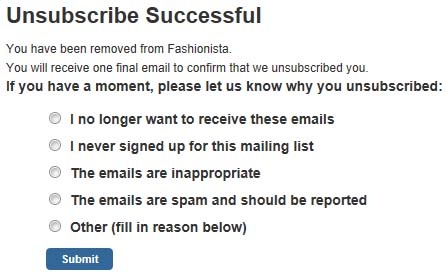
7) Solicit feedback from unsubscribers: You may have seen a short multiple-choice survey asking why you unsubscribe and be given reasons to choose from, like "I no longer want to receive these emails", "I never signed up for this list", "The emails are inappropriate" etc. This data is helpful for you to know why your former subscribers leave and to improve on your email campaigns in order to lower unsubscribes in the future. Again, consult your mailing service staff to find out you can incorporate this survey in your unsubscribe page.

8) Ensure your email design is optimized: As more people read their emails on mobile, marketers need to carefully consider how best to present their content, whether it is necessary to trim down content (be light on text and graphics) due to smaller screens and the on-the-go lifestyle and whether their audience is still predominantly desktop users, therefore sacrificing mobile users is worth the trade-off, etc. These factors will influence how your email design will stay relevant with the times so that you can provide several options to the way your emails are read on different devices.

Understanding why people remove themselves from your list—and knowing how to re-engage with them—can help you maintain a healthy audience for email readership. Giving customers what they want is also crucial in keeping them engaged. Of course, I'm sure there are more than 8 major ways to bolster your email marketing effectiveness while reducing unsubscribes. Share with us in the comment section below what you do to lower unsubscribe rates.

Thursday, 31 March 2016

Designing Customer Satisfaction Surveys That Work

Designing Customer Satisfaction Surveys That Work
Why bother?

Good customer service is the life blood of any business. Although new customers are important, good customer service will help generate customer loyalty and repeat business. With each satisfied customer your business is likely to win many more customers through recommendations and remember, if you are not taking care of your customers, your competition will.

Online customer satisfaction surveys will help by not only identifying problem areas but show that you care and are proactive in looking for ways to improve the service that you provide.

Where do you start?

Objective - Before you start creating your survey clarify the objectives of the survey, in that way you will find it easier to decide what are the right questions to ask.

Analysis - Consider how you will analyse the answers having completed the survey.

Keep in mind that 'closed' questions (where a respondent is asked to choose from a limited number of responses) are much easier to analyze than 'open' questions (where the respondent can reply in anyway they want).

A lot will depend on the predicted volume of respondents, the higher the volume the more important it is to have an easy method of analysing the results.

Opportunity – As well as obtaining valuable market research data keep in mind that customer surveys are also a good way to publicise aspects of your service that your customers may not be aware of.

Before you publish the survey confirm that the questions you have asked will provide you with market research data that when analysed will help you make informed decisions.

Then, from a marketing view point read through the survey, confirm that you have phrased each question so that every opportunity has been taken to promote your business?

The ideal question will perform the following 3 functions:
  • Market research - provide valuable feedback to help you improve your customer satisfaction levels and in turn your business
  • Marketing - promote aspects of your business
  • Information/Education - advertise a service that you provide that your customers may not have been unaware of
For example: Do you find the in-store baby changing facilities useful?

By asking this question not only will the store receive good market research feedback on the facility they provide but they will also promote their facilities and advertise themselves as a family friendly store, even beyond those customers who have a specific need for the baby changing facility that has been provided.

Warts and all – to benefit most from a customer survey you need to be prepared to dig deep and accept the worst.

A customer satisfaction survey should be designed to identify any problem areas so that they can be fixed; conducting regular customer satisfaction surveys will help prevent complacency and will also give early warning on where you may be losing business to your competitors initiatives.

What are the questions you should ask?

Each business is likely to have unique factors in relation to providing good customer services however there are common areas that are going to be relevant to all businesses be they a physical store, online store or a service industry. The following are some key areas to providing good customer service.

Communication - What do you do to help your customers communicate with you?

When customers telephone are their calls answered quickly; are their enquiries about products or services handled properly? Good businesses will make every effort to ensure that whatever the customers query it is resolved by the right person, quickly, politely and fairly.

If customers reported problems that cannot be resolvable immediately do you promise to respond in a given time period and do you deliver on your promise?

Use a customer satisfaction survey to ensure that all your staff are considered by your customers to be knowledgeable, courteous and helpful.

Location – Are you doing everything you can to ensure that your customers find it easy to visit you, if a physical store, does it have good access and is it conveniently located?

Making it pleasant, making it easy - For an online business it is important to ensure that your website is easy to use and aesthetically pleasing.

Physical store or online website, is the store properly laid out, can your customers find what they need and is there sufficient information and help on hand to explain how a particular product works?

The right quality products – You should not only measure the quality of the service that you provide but you should also monitor that the products and services that you market are what the customer wants and closely match their expectations.

Value for money – Cheap or expensive is not always a good measure, value for money is.
Is your business associated with value for money by your customers, if not, why not?

Speed and attention – Customers want to be dealt with quickly but attentively.

Are you doing everything you can to avoid delays?

Good businesses will try to treat each customer as an individual, does yours? Customers appreciate attention but only if it leads to a quick and satisfactory resolution of the query.

Demographics and Specific issues – Take the opportunity to profile your customers, for example where do they live and what is their age group?

Understand your customers more and you will be able to better target your business.

As part of the survey allow your customers the opportunity to highlight any problems that they may have and provide you with contact details so that their problems might be later addressed and their concerns followed up.

What next?

Once the survey has been completed analyse the results.

Trends – Identify common and specific areas where the service needs improving.

Ask yourself honestly if any criticism that you receive is valid and if there anything that can be done to resolve or minimise the problem?

Training – Are all employees properly trained and do they have sufficient knowledge?

Where employee training programmes have been implemented have they made a positive contribution to the business and improved the customer service?

Follow-up – If a customer has raised a specific issue through completing a survey ensure that they are contacted and that their complaint is properly addressed.

Do not squander the opportunity to resolve a problem and keep a customer.

Continuously Monitor - Based on the survey results make changes and then re-measure by issuing further surveys.

Resources

Customer Satisfaction Survey Template

Customer Satisfaction Survey Questions: 5 Sample Templates You Can Use Right Away

Sunday, 13 March 2016

7 Social Media Marketing Myths You'd Never Expect

7 Social Media Marketing Myths You'd Never Expect
Social media has become very popular in the digital marketing world. Brands cannot resist on using social media on their digital marketing initiatives. It has become a necessity to have a social media presence in order to reach out to the target customers.

Most digital marketers have used social media, however there are still some false beliefs that need to be cleared. Because of the fallacies and wrong expectations, digital marketers tend to believe that their social media campaigns do not work. If you are already using or considering using social media for your marketing campaigns, you should keep in mind these 7 social media marketing myths to set your expectations straight.

1. Social media marketing is free. Although social media signup and usage is absolutely free, using it for marketing purposes is not. Using social media in the leisure manner that you normally do will not give you the results you expect. You need to do social media advertising to reach the target audience. You need to post good content that is aligned to your marketing goals to entice your audience. You have to come up with a nice banner or image to make your post appealing. You may even need to create a video to make your content more interesting. All of these will cost you money one way or another.

2. You can easily make your content viral. Sure this happens sometimes, but very rarely. In order for your content to get a lot of attention, you have to work really hard on pushing it to your audience. No matter how good your content is, someone still has to see it and recommend it to others. Regular sharing and advertising are some of the things you may consider doing to promote your content.

3. You need to use all the big social media sites to succeed. This is not necessary. You should just focus your energy on 2 to 3 sites that you think are applicable. This all depends on your target audience. You have to figure out what social media platforms your target audience is in. For example, if your target customers are specifically professional marketing managers, LinkedIn should be the social media of focus here. Then consider 2 other secondary platforms that these marketing managers may be using.

4. Social media is only for the young ones. This might be true in the beginning but not anymore. According to a study conducted by iStrategyLabs, Facebook has 276% growth in users aged 35-54 in 2009 and is its fastest growing segment. I have a first-hand experience on this. My parents and all their friends are really into Facebook. They use it to reach out to their old friends.

5. You should make money on all the content you share in social media. In social media, the more you give, the more you receive. The main purpose of sharing content is not to make money out of it but to build credibility and trust. Once you have established yourself as an expert in your chosen business niche, then people will start looking for you to see how you can help solve their problems or challenges.

6. Social media is everything you need for your digital marketing. Though social media is a very powerful marketing tool, you should not forget about other marketing tools out there. Social media should be a part of your integrated marketing communications strategy whereby you use as many marketing tools you can leverage on as possible. There are other aspects of marketing that social media cannot cover so you should have other tools to cover the rest.

7. Social media results cannot be measured. New tools to measure social media results are popping up on a regular basis. There are tools that can measure blog comments, mentions in the media, traffic stats, Facebook fans, Twitter followers, comments on your content, real-time blog advertising results, click-throughs to your website etc. You just have to do more research to be updated on these tools.

There are other myths on social media that I did not cover. You will realize them as you progress in your journey with digital marketing.

How To Monitor Your Social Media Presence In 10 Minutes A Day

Thursday, 10 March 2016

Tweaking The Numbers In Google AdWords

Tweaking The Numbers In AdWords
Google AdWords is a simple and easy-to-use advertising program, offered by Google, which works on a pay-per-click principle. You pay Google a predetermined amount of money each time a person clicks on your ad.

Of course, what you pay for it determines where it will be displayed in the Google search results! The primary goal is to strike the best balance between the cost and the ranking. Here is some tips for you to minimize your cost in setting up your Google AdWords campaign and increase your revenue.

Placing The Right Bid

Just like you optimize your website for keywords, you have to optimize your AdWords too. This is done by "bidding" for the relevant keywords from Google; choosing the amount you are willing to pay per click for that keyword, which, in turn, determines the location of your ad in the search results. For U.S. customers, this amount can be as low as one cent per click and as high as the competition drives it! While it is not wise to set too high a price initially, it can also render your entire campaign worthless if nobody gets to see your ad! Finding a balance between the position of your ad and the CPC is your first step towards PPC success.

Analyzing And Modifying

Ideally, you should start with 1 cent CPC for all your keywords and gradually increase it by a cent each for those keywords which are suspended by Google because of being too low priced. Once you have more than half of your keyword list working, stop playing with the CPC for the keywords until you get at least 50-75 clicks. You can start analyzing which keywords seem to be working for you at the low CPC and which need further investment.

Testing And Tweaking

Once you manage to cross phase 2 of the campaign, now you need to keep it going by revising, testing and refining your ad. You need to adjust the header, the design and the bid value. You need to keep finding ways of improvement!

Once you develop a certain comfort level with AdWords, it can actually be quite fun! Whether you are a total novice in the field of Internet marketing or you have been around for a while, but not with much success, I am sure that if you keep the above few AdWords tips in your mind, you will be able to see a definite success in all your AdWords campaigns! Playing smart is the operative word here!

Wednesday, 9 March 2016

How Telemarketing Is Changing In The 21st-Century Marketplace

How Telemarketing Is Changing In The 21st-Century Marketplace
Telemarketing is a pretty old business. Telemarketing got its start in the 1950s and has not changed much since it began. The earliest forms of telemarketing were generally used to sell magazine subscriptions to customers through the phone, using a system of database marketing. Gradually, more soliciting was done over the phone, until it got to the point that telemarketing calls were being made at all hours of the day and evening.

At this point, the government stepped in and started invoking laws for direct marketing so that the telemarketing companies were not able to call as often. This was good for prospects, but of course, it was bad for the telemarketing companies. Some of the laws that were imposed on the telemarketing companies encompassed things such as the time when they could call, being required to stop calling if someone asked to be removed from the call list, and introducing the national do-not-call registry.

This enabled people to take themselves off any telemarketing list, making it illegal to call them for any kind of solicitation. With so many people taking themselves off of the solicitation lists, the telemarketing companies have had to turn to other means of income generation to keep themselves in business. Now, many telemarketing companies are adapting or integrating telemarketing processes into digital marketing to keep turning a profit.

The traditional telemarketing sales format is not used in a digital marketing strategy. Some companies are still using outbound telemarketing by having people set up appointments on the phone to be finished later over the Internet. Another way to bring telemarketing into the future is through the creation of the virtual call center. This saves the telemarketing companies money because people are working from home for a reduced salary, thus reducing their overhead costs.

A good digital marketing strategy is needed to play a larger role in the sales process for telemarketing to stay relevant. Some companies have completely switched to the Internet as a means of saving business costs by having people call from home through a virtual call center. Other marketing companies are changing their focus completely to address the new interests of today's society. Overall, the world of telemarketing and direct marketing is changing and will never be the same again.

Monday, 7 March 2016

How To Conduct Social Media Monitoring

How To Conduct Social Media Monitoring
Social media monitoring has increasingly become a crucial practice in gauging who said what about your business and the degree of positive and negative sentiments associated with the opinions. As an integral part of prospect/customer engagement, marketers can harness SMM for improving customer service, minimizing damage control, projecting a better brand image, identifying potential brand influencers and advocates and basically keeping tabs on your industry or niche (for further information, read "6 Ways Social Media Monitoring Can Benefit Your Business"). The sentiment data acquired through SMM can also be analyzed to determine future improvement to social media marketing campaigns and the products/services themselves.

The metrics to monitor and measure are spelt out in "The Ultimate System For Tracking Engagement On Social Media", but not all metrics matter to you until they align and contribute to your engagement goals.

Social media monitoring tools can run the whole gamut from being easy-to-use to being highly sophisticated, from being free to costing a monthly subscription (do a Google search for them). You can easily set up a simple tool like Google Alerts to notify you of certain keywords. These notifications will bring you to the keywords' mentioning sources whereby you can respond to comments or opinions. For a start this is pretty straightforward for newbies. As you sieve through the data, it gets pretty interesting to learn what others have been talking about in relation to your business, products/services, niche or industry.

It gets a little heady if you need to canvass more data, but don't worry. I list out 5 free ways you can monitor and act upon the data you are targeting in the major social networks.

1) Check Twitter for chatter about business (2 minutes): Use tools like TweetDeck or HootSuite to monitor conversations about your company in real-time. With these tools, you can save searches and react via the tool itself without needing to log into Twitter. Alternatively, since Twitter has discontinued its own native RSS feeds, follow this workaround to create your Twitter feeds and include them in feedly.

2) Scan Google Alerts (1.5 minutes): Check your Google Alerts for your company name, products, executives or brand terms. To set this up, enter your search terms and select to receive updates as they happen or once daily. Now, when people blog about your products, an alert will be sent to your inbox. You can read the articles and respond right away!

3) Check Facebook stats (1 minute): Visit your company page's Facebook Insights. Scan your fans and page views count. If you are a member of a group, check to see if any new discussions started.

4) Answer Industry-related LinkedIn questions (3 minutes): Search for questions on LinkedIn that you or members of your company can answer. You can set up an RSS feed for specific question categories to go to your RSS reader e.g. feedly, as well. When you find a relevant question, respond and include a link to your website.

5) Use your RSS reader to check Flickr, Delicious, Digg and others (2.5 minutes): Also set up RSS feeds for searches on your company name and industry terms in other social media sites. Similar to monitoring LinkedIn and Twitter, your reader will serve as a great place to centralize your other searches too!

How To Monitor Your Social Media Presence In 10 Minutes A Day

Sunday, 6 March 2016

Ultimate Tips for LinkedIn Groups to Generate Sales Leads

Ultimate Tips for LinkedIn Groups to Generate Sales Leads
Are LinkedIn Groups effective for promoting your business?

My short answer is 'yes' and here's why...

LinkedIn Groups are virtual meeting rooms (or forums) where people with similar interests can post and hold conversations around topics they want to share or learn more about.

For those of you who have been leveraging LinkedIn Groups for a while, you may be aware that LinkedIn recently made some pretty big changes. Groups are now private and membership must be approved (though once you're in, your conversations no longer require moderation), and there is no longer a promotions tab or subgroups.

Participating in Groups allows you to show off your expertise around a subject and start to grow relationships with like-minded people.

Many of these people may be colleagues, who could offer solutions to certain challenges you've been facing, or could provide partnership opportunities to help you grow your business in the future.

Others could be potential customers, who are using groups to network and also find solutions of their own.

By sharing your expertise, participating in conversations, and being a reliable source of information within the Group—you'll have the opportunity to build valuable relationships to help you do more business.

How do I find and join the right Group?

LinkedIn makes it easy to find Groups that are relevant to your business, or the audience you're trying to reach. Within LinkedIn, you can perform a search based on keywords and filter to find the right Group.

For each Group found in your search, you have the option to view who in your network belongs to those Groups. Joining Groups that your connections are already members of can help you nurture the connections you've made on LinkedIn.

Take it one step further and reach out to your network to ask them what they think about the Groups they belong to. This can help to continue building the relationships you already have, while starting to understand what Groups may be right for you.

On LinkedIn there are both public and private Groups. If they're public, all you need is to hit the 'join' button when you find a Group you're interested in and you'll gain access instantly. Private groups on the other hand, require you to request an invitation from the manager of the group to get access.

You can join up to 50 Groups, but be aware that many groups aren't actively managed. Make sure to spend the majority of your time on the key Groups you find that are managed well and have constant interactions.

How do I participate in a Group?

When you join a Group, take the time to familiarize yourself with the content people are sharing, and types of questions that are being asked.

Relevant content is the only way to take full advantage of a LinkedIn Group. When you share content that others are interested in, your chance of 'connecting' with that person is much higher than if you just hit 'connect.' Use groups to strengthen relationships, with your ultimate goal of connecting on and offline with Group members.

Here are a few tips to remember when participating in a LinkedIn Group:
  1. Show off your expertise by answering questions that others have asked, and don't forget to ask some questions of your own! Groups are meant to be a forum for like-minded people, so make sure you're asking and answering.
  2. Post articles and ask questions. Share articles or blog posts you've found and ask the Group members a question related to the article.
  3. Don't over-promote! Your goal when posting articles or answering questions is not to promote yourself or what you're doing, but to build relationships. When you use the words 'me', 'I' or 'my', your content will more than likely get sent directly to the 'promotions' tab of the Group.
  4. Make that connection. Once you've been interacting with someone in your Group, and you've built up some familiarity, send them an invitation to connect on LinkedIn. Make sure to let them know why you want to connect, and remind them of your interaction in the Group.
  5. Don't forget other networks. If you have been interacting with someone on numerous occasions in a Group, connect with them on Twitter or find their business page on Facebook. Most people are participating in a Group for the same reason you are, so they will be happy to connect with you and extend your relationship!
Are LinkedIn Groups really worth the time and energy?

Hopefully, by now, I've convinced you that the answer is YES! The ability to reach people you wouldn't otherwise have access to is one of the main reasons that social media works, and LinkedIn Groups are no exception.

Get out there, begin by joining 3 groups and see what relationships you can build by engaging with the right audience.

How To Monitor Your Social Media Presence In 10 Minutes A Day

Thursday, 3 March 2016

3 Ways Quora Can Supercharge Your Business

What can a Q&A site do for my business, you wonder?

Promoting my business on Yahoo! Answers? Maybe that's not what you had in mind.

Yahoo! Answers

Source: BuzzFeed

Quora? What's Quora?

Quora is a community-based Q&A platform where anyone can ask and answer questions.

Quora

What distinguishes it from Yahoo! Answers, then?

Quora is one of the few communities that have founders of renowned companies like Wikipedia, Pandora and Craigslist as regular contributors. They also have representatives from other companies like HubSpot Singapore and Moz contributing their expertise and knowledge on their subjects for free.

The Quora community also covers a tremendous scope; from the digital marketing industry, entrepreneurship, the latest happenings in Silicon Valley to life advice. People actively ask questions and seek answers to these questions.

What do all these factors mean for you as a marketer trying to promote your business?

#1: Quora is a place to establish thought leadership for you and your company.

People on Quora actively ask questions and look for answers to these questions.


Browse, find and follow relevant topics to follow on Quora that your business is working in or have expertise in. For example, if you are a marketer in a digital marketing agency you can follow and monitor topics related to social media, SEO and marketing analytics.

Following these topics gives you access to the multitude of people looking for answers in your topic of expertise. These are opportunities for you to demonstrate your expertise, provide value to your prospective audience and get your brand name out there.

Two types of answers are especially popular on Quora:
  • Actionable strategies
Examples include: How to X, What is the best way to do Y.
  • Specific examples
Examples include: 21 Examples of Amazing Headlines, 3 Examples of Stunning Personal Websites, 5 Examples of Outstanding Resumes.

Providing concrete examples and visuals to answer a question makes your answer easier to understand and provide more value to your audience.

These strategies on Quora can help to establish you and your company as a source of strong, relevant information for your area of expertise.

#2: Quora can drive traffic to your company website or blog.


Use existing content on your blog or website to answer existing questions on Quora. As you answer these questions, include a link back to your website or blog with either a more detailed answer or more relevant examples that viewers can read more about if interested.

As your Quora answers gain in popularity, make sure you include a link to your website or blog post you are quoting to ensure it becomes a source of social referral traffic. The Quora community is made up of dedicated users and its carefully curated content ensures it is well positioned as a source of reliable, high quality information.

Establishing your brand on Quora allows you to build relationships and trust with prospects to organically guide them to discover your brand's products or services. This process takes time, but will drive qualified and warm leads to your website as you nurture these relationships.

#3: Quora is a place to find, listen to and engage with an audience who is relevant to your company.


Quora is a wonderful way to learn specific details about your core audience. Its Q&A format allows your brand to discover the answers to the following marketing related questions.
  • Who are my customers?
  • What are their wants and needs?
  • What challenges / problems are they facing?
  • What are they looking for in potential solutions to these problems?
  • What are my competitors offering already and how can I differentiate myself from them?
Do your research on Quora! By focusing on what your prospects are saying in comments or what questions they are asking, your company can gain insight into your audience's characteristics and more importantly, how to create appropriate content to address these needs.

Quora is one of those Q&A sites done right. Quora admins continuously ensure answers are of high quality and the community remains respectful in comments, questions and answers. Quora may just be that listening and traffic generating platform your business needs.


How To Monitor Your Social Media Presence In 10 Minutes A Day

Wednesday, 2 March 2016

Article Marketing: What Makes A Good Article?

What Makes A Good Article
We all know the raw power and efficacy of online marketing through article publication. All of us can even claim without blinking that article marketing is the most powerful and cost-effective web advertising technique that has been conceptualized since the creation of the digital world.

To put it simply, if you own an Internet enterprise, you have to use article marketing.

However, one of the most asked questions I receive is this: how can I craft a good article?

What Makes A Good Article?

This indicates that though most Internet businessmen realize that they have to pursue article marketing, not all of them are skilled enough to write a web-worthy piece of informative content.

Therefore, I have prepared some easy-to-follow steps on how you can create the most suitable good article for online marketing purposes.

1. Determine the subject you want to write about.

2. Don't attempt to write about a general subject. Break it down to a more specific subject that people will be fascinated with. Just to illustrate, don't settle for the broad subject of 'dogs'. Try to determine a sub-topic that will capture the interest of the prospects you will be aiming for. As is often the case, this sub-topic refers to a particular demand, like "dog training" for people who are experiencing difficulty when it comes to living with their unruly canine companions, or "dog grooming" for cleanliness compulsive dog owners who can't live with the smell of their untidy canine friends. You need to find a sub-topic that will make people take notice. This is critical. Countless articles fail because they don't serve a more tangible matter.

3. Because the sub-topic should indicate a need, your article must be able to provide a solution. However, depending on how the article will be used, the solution you will share will vary. By way of example, if you're going to use the article to promote a product, then practice restraint on the remedy you will share. Your goal, in such a case, is to provide the impression that you are an expert in the field, and invite your readers to consider what you will be offering. Always remember this throughout the writing process.

4. Formulate an attention-seeking title that is dumbed down but exciting. People will visit your article if they will like its title. If not, no one will get to read what you have written.

5. Remember that every article has 3 basic parts: the introduction, the body, and the conclusion. The introduction will introduce what your work is all about. You can deliver a shocking fact, a revealing statistic, or a funny anecdote to jerk your audience into knowing that "Yes, the author is the real deal." The body will discuss the information you want to share, of course. And the ending will summarize the problem, the provided solution, as well as interject some calls-to-action (i.e. "click my link") if needed.

6. What is the right length for articles of this nature? It's safe to say that 300 to 750 words would be fantastic!

These are just some easy tips for article writing. It is not hard to write a good article all it takes is a little planning and a little thought. With practice you will find it gets a lot quicker.

Tuesday, 1 March 2016

Article Marketing: Effective Website Advertising Tactic

Article Marketing: Effective Website Advertising Tactic
By using the Google AdWords Keyword Planner, you can see the thousands of searches done to a certain keyword. When these keywords are typed on search boxes of search engines, indexed websites containing articles with those keywords will be displayed. And this is what leads traffic to websites with keyword-rich articles.

Content is king. You can say that again. That is why articles are one of the most utilized digital marketing media today. Internet surfers just can't get enough of information on various fields. Giving them the information they need is the most straightforward way to give your site free traffic.

Why is this so? Here are the benefits that writing articles can give your Internet business, and how a proper article marketing strategy can increase your website ranking faster than any other technique.

1. It's absolutely free.

Too good to be true? Not. Alright, so you have pay your Internet Service Provider. That's it. All you need is your thoughts, your computer, and your hands. If you have those, nothing will stop you from typing words that will make you complete that article for your website. On which aspect of that process did you really shell out any cent? Maybe later when your electric bills come.

2. Your website will be noticed in a short period of time.

Submit that article of yours to article directories that get the most Web traffic and in no time your website will be crawled. Just don't forget to place your resource box or byline in your article.

3. Obtain back links automatically.

When you submit your articles to directories, surely, other websites will make use of your article too. With the copyright terms of your articles, the URL of your website will still be in tact and will subsequently direct more traffic to your website. So always keep in mind how important is to use a correct tool to submit your article to the proper sites.

4. Improve your reputation.

As an Internet marketer, if you plainly display your products on your website, you will not gain much conversion rate. Conversion only happens when your website visitors actually buy what you are selling. You have to show that you are knowledgeable on your field. Write useful articles to demonstrate your expertise to your website visitors.

Just make your creative juices flow and jot down or key in those ideas quickly to jumpstart your article writing momentum. With those benefits listed above, a writer's block is the last problem you will ever be able to surmount.